
Motivation Through Modelling
What makes a child want to learn? ✨

It’s easy to think we need to coax them along — with praise, reward charts, sticker systems, consequences, and carefully curated activities. But when we really slow down and watch, we start to see something quieter at work: children are driven to learn because they are wired to imitate.
🕊️They learn because they see us, watch us, imitate us. Our way of being in the world is their curriculum. And this doesn’t begin in some abstract future when they’re “school-aged.” It begins in the early years.
If you never bring your child into the kitchen with you, how will they ever develop an interest in cooking? If they don’t see you reading for pleasure, why would they choose to pick up a book? If they never see how a home runs, how can they join in later with purpose?
Not only do early exposures matter, but so do the invitations to join in. 💌
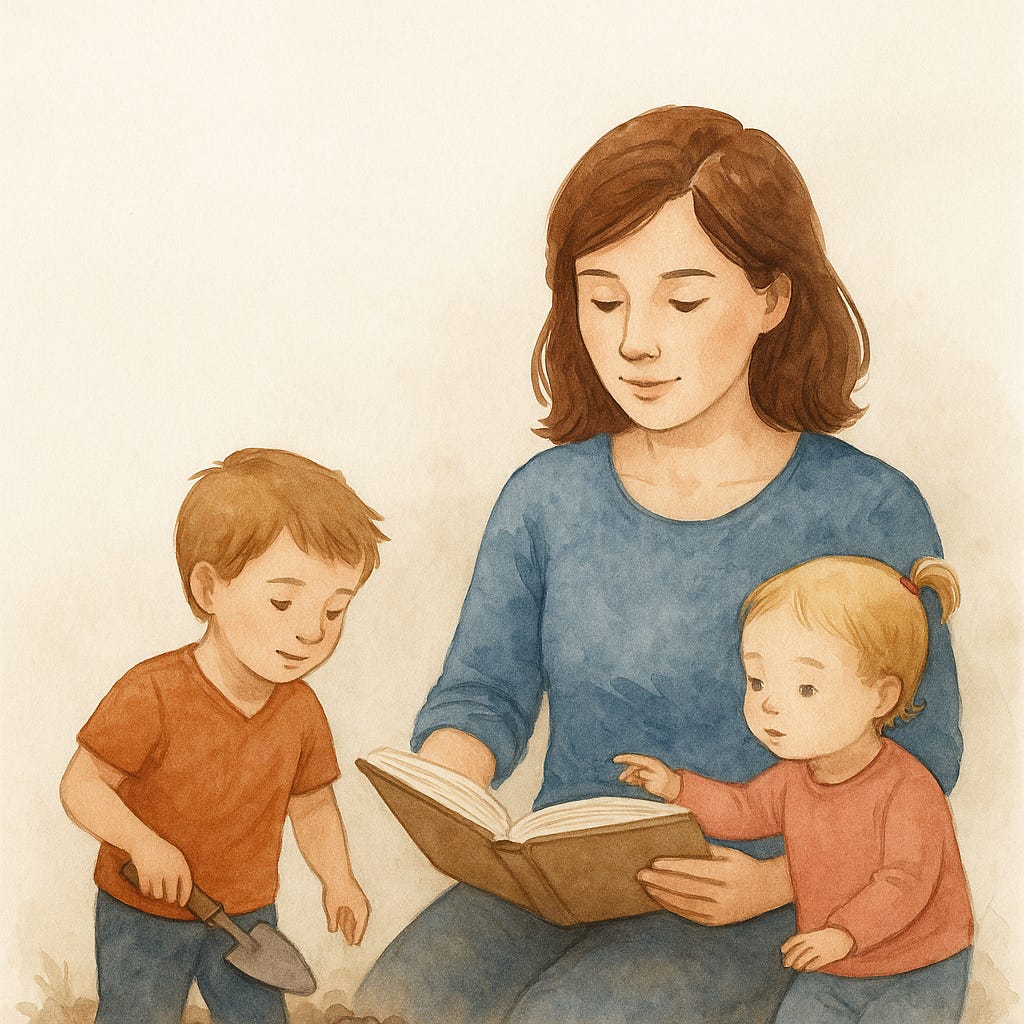
This can often mean giving up control. For example, standing back when your toddler finally asks if they can hold the shovel in the garden and letting them try. Even if they do a messy job. Even if you’re nervous they might hurt themselves. Even if it undoes your progress and you have to come back later to fix it.
We keep an eye out for real danger, of course. But scraped knees, spilt dirt, uneven cupcakes, torn pages — these are part of the process. When we protect them from every possible mistake, we also rob them of what those mistakes have to offer: the chance to learn something new.
🧺 As any stay-at-home mom knows, this is not always easy. We’re often the ones carrying the mental load of the home, trying to get the laundry done, make a decent meal, and keep things somewhat in order. Allowing a child to “help” can feel like an obstacle. But that momentary inconvenience? It sets you both up for success.
Because when you let them participate, they learn how to be helpful. And eventually, they help autonomously. They won’t need your supervision or your guidance. And it won’t be because you made them — but because they’ve learned this is what members of a family do. 🏡
So much of our culture tries to compartmentalize education, separating “learning” from “life.” But when we return to a more natural pace — when we bring our children close to the rhythms of our real days — learning reawakens in its original form: lived, observed, absorbed. We don’t need to package learning into perfectly planned lessons. 🍃
We learn math while baking.
We learn science on a walk through the woods.
We learn storytelling at the dinner table.
We learn responsibility by feeding the dog.
We learn empathy by watching someone comfort a crying baby.
📚 If I want my toddler to love reading, I take him to the library with me. He watches me pick out a book, scan the shelves, and select one that sparks my curiosity. At home, I make sure he sees me reading it — not as a lesson, but simply as part of life. I ask if he’d like to read a book too. Sometimes he says yes. Sometimes no. I don’t push. I just leave the book nearby, knowing that curiosity can be sparked at any time.
🧮 If I want him to understand math, I let him be part of our everyday numbers: scooping flour, counting grapes, setting the table. His father includes him in measuring a piece of wood for a project he’s building, counting the number of screws needed. I bring him to the store. He sees me make choices, pay for what we need, interact with others. I invite him to participate when he’s ready.
I don’t need to be an expert in every subject. I just have to be a person who still believes in learning. A person who picks up a book, who asks questions, who experiments, who makes mistakes and tries again.
This is the magic of motivation through modelling: it doesn’t rely on strategies or systems. It asks only that we be who we hope they become. 💛
✨ Want to keep walking this path together?
Subscribe below if you’d like to receive gentle reflections on slow motherhood, unschooling, and family life — right in your inbox.
💌 And feel free to reply — I’d love to know what brought you here.