
Hunt, Gather, Unschool: Ancient Wisdom in a Modern World
How Hunt, Gather, Parent inspires our unschooling journey. 🌿

Introduction 🕊
When I first read Hunt, Gather, Parent by Michaeleen Doucleff, it felt like a deep exhale — a reminder that parenting doesn’t have to be complicated or busy. The book explores how Indigenous and traditional cultures around the world raise children who are kind, capable, and cooperative — not through rigid discipline or endless praise, but through connection, community, and shared purpose.
So much of what Doucleff describes resonated with the kind of motherhood I longed for, and the kind of childhood I hoped my children would know. Reading it gave language and shape to instincts I had been quietly following since becoming a mother — to slow down, to invite my children into real life, to trust them, and to see learning not as something to schedule, but as something that naturally unfolds in relationship. ✨
A Quick Summary of Hunt, Gather, Parent 📚
In the book, Doucleff travels with her young daughter to live and learn alongside families in three traditional communities: the Maya in Mexico, the Inuit in the Arctic, and the Hadzabe in Tanzania.
What she discovers is both simple and profound — that parenting in these cultures is rooted in a handful of shared principles:
Children are trusted and capable.
Adults assume competence and invite children to participate meaningfully in daily life. 🌱Learning happens through doing, not through lectures.
Children learn by watching and joining in, not through formal instruction. 🖍Parents are calm and connected.
Instead of constant correction or praise, parents model steadiness, emotional regulation, and cooperation. 🕊Community over control.
Raising children is shared work; everyone contributes, and no one person bears all the weight. 🌾
These insights stand in gentle contrast to much of modern Western parenting, which often isolates families, prizes achievement over connection, and turns a deeply human process into something that feels endlessly managed. In a culture that glorifies independence, mothers often find themselves seeking guidance in the only village readily available — the internet — when what we truly need is one another. 💌
How We Live These Principles Through Unschooling 🌱
1. Learning Through Living 🧺
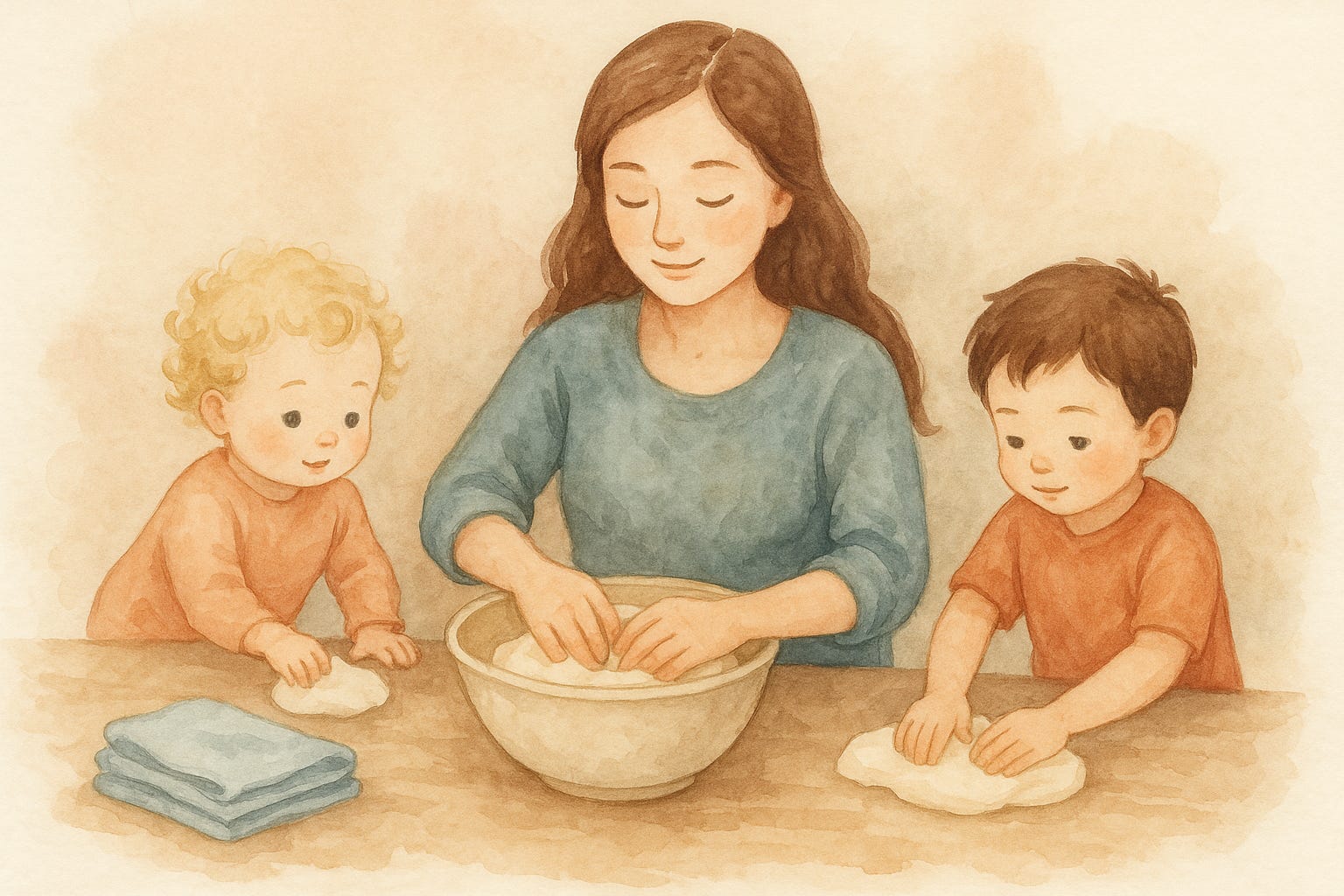
In our home, “school” looks like baking bread, mending a broken hinge, or noticing the calls of birds on a morning walk. Just like in the Maya villages Doucleff describes, I’ve seen how my children thrive when they are invited to join in meaningful work — not as helpers in a play version of adult life, but as real participants in it.
Unschooling allows the boundary between “education” and “life” to dissolve completely. We don’t sit down to teach; we live, and learning happens in the flow of living. It’s in the kneading, the wandering, the fixing, the tending — small acts that teach patience, confidence, and belonging. 🍃
2. Collaboration Instead of Coercion or Distraction 🕊
One of the greatest lessons Hunt, Gather, Parent offered me is that cooperation isn’t demanded — it’s modelled.
At first, it felt easier to do everything myself — to cook and clean efficiently, to manage the tasks quickly so I could move on. But I realized that in rushing through, I was missing the chance to draw my children into the rhythm of our home.
Now, instead of asking them to help, I simply include them: “Let’s make the dough,” or “come hang the laundry with me.”
These statements are calm and confident — not commands, but gentle invitations to join in meaningful work. The goal isn’t perfection or speed. It’s belonging.
When we do these things together, I learn to release my grip on efficiency, and my children learn what it feels like to contribute to something real. Through that rhythm of shared work, we both find a slower, steadier way of being. 🫖
3. Emotional Regulation Begins with Me 🌙
The stories of Inuit parents never raising their voices stayed with me. Their calm presence teaches emotional steadiness far more effectively than any lecture ever could.
I’ve tried to bring that into our home — to breathe before I respond, to lower my voice instead of lifting it, to remember that connection always matters more than correction. My calm is the anchor from which they learn to steady their own. 🕊
4. Community and Shared Responsibility 🌾
Unschooling can sometimes feel lonely in a culture that prizes self-sufficiency, but Hunt, Gather, Parent reminded me that raising children was never meant to be a solitary act.
We’ve sought out a small circle of families who share our rhythm and values — not to recreate a classroom, but to rebuild a village, where children and adults alike feel seen, useful, and connected. Together, we trade stories, share meals, and watch our children grow not just under our eyes, but within a web of belonging. 🌸
Closing Reflection ✨
Unschooling isn’t simply an educational philosophy; it’s a way of being in relationship with our children and the world around us. Hunt, Gather, Parent reminds me that the wisdom we need isn’t new — it’s ancient, woven quietly into the fabric of everyday life.
Blending its spirit with our unschooling rhythm has made our days feel lighter and more grounded. We’ve let go of outcomes and leaned into togetherness. Our home feels less like a school and more like a living ecosystem — a place where learning, care, and contribution flow naturally between us. 🌿
When we slow down enough to listen, to trust, to live and learn side by side — we begin to remember what it truly means to raise children. 🍂
✨ Want to keep walking this path together?
Subscribe below if you’d like to receive gentle reflections on slow motherhood, unschooling, and family life — right in your inbox.
💌 And feel free to reply — I’d love to know what brought you here.